
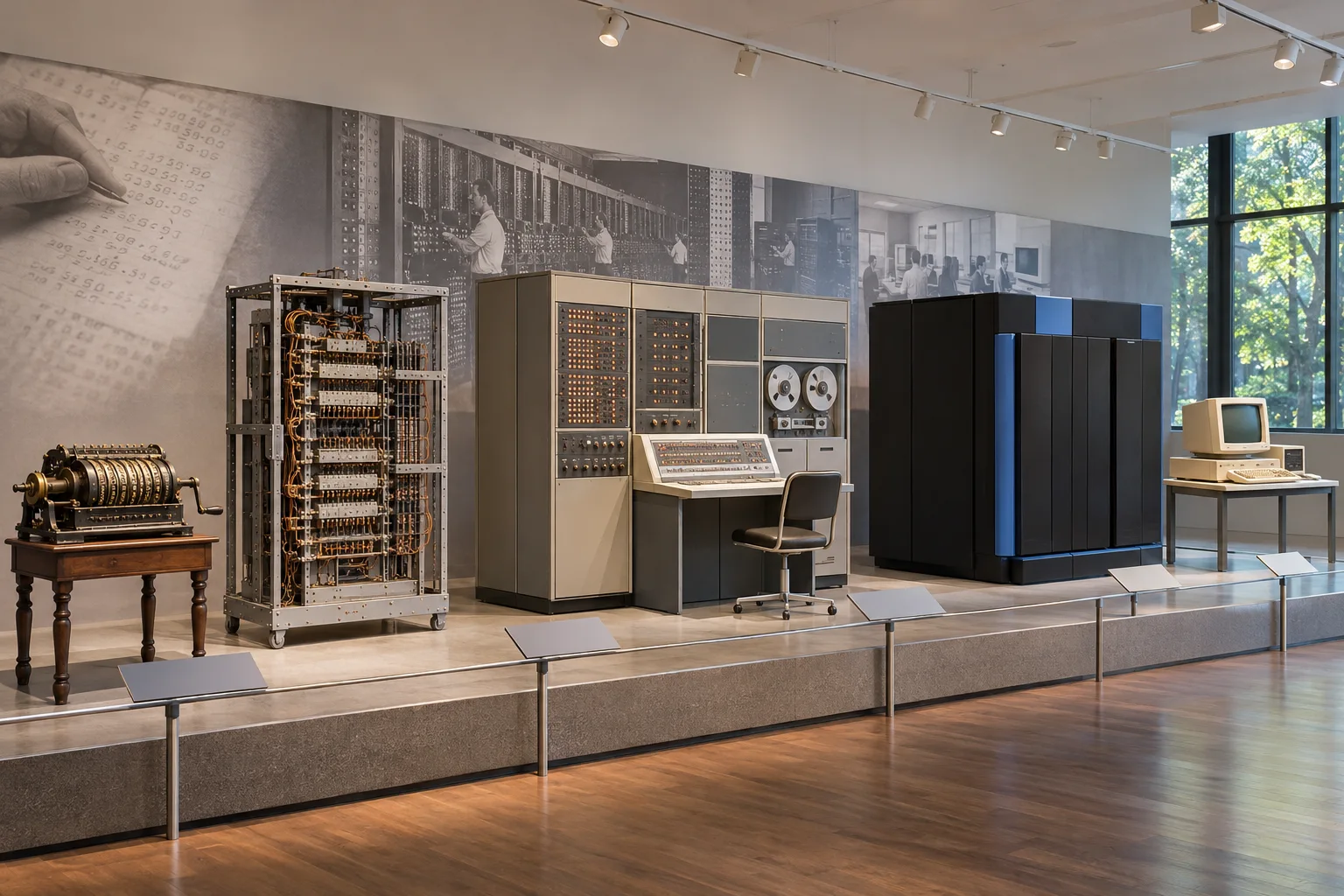
Computing developed through overlapping waves of research, engineering, business, and personal use. This timeline is a starting point for understanding how machines moved from specialized rooms into everyday life.
Before electronic computers
People used mechanical calculators, punched cards, tables, and manual procedures to organize information. These systems reveal a central theme in computing: the desire to make calculation and data handling more repeatable, reliable, and useful at scale.
Electronic research and early systems
During the 1940s and 1950s, electronic digital computers were developed for scientific, military, and administrative needs. Early systems were large, costly, and operated by teams. Their stories involve not just circuitry but also programming methods, institutional funding, and the work of operators.
The mainframe era
From the 1950s through the 1970s, larger organizations used centralized computers to process payroll, records, research data, and business transactions. Time-sharing and terminals helped more people interact with shared systems, while software and operating procedures became increasingly important.
Personal and connected computing
Microprocessors, affordable computers, graphical interfaces, and expanding networks changed who could use computing and where. Home, school, office, and online technologies developed at different speeds, shaped by markets, standards, public policy, and user communities.
Keep exploring
Continue through Hariax for more computing history, object stories, and practical learning ideas.
Explore collections